Category Archives: Mining News & Views
Natural Resource Road Act: Discussion & Feedback
Ministry of Forests, Lands and Natural Resource Operations Home
http://www.for.gov.bc.ca/mof/nrra/
DEAR CMA MEMBERS,
The Natural Resource Road Act is in the works and we have until December 15th to submit any questions, feedback, recommendations, and so on to the ministry. Please try to read through the information and also use the links (highlighted text) to download any documents you wish to read and use.
All the information below is on the ministry website and you can go there to fill in whatever feedback you may have. Or you can just copy and paste the information off this page and send in your feedback using the email address provided.
Thanks,
Arthur
Webmin
———————–
Ministry of Forests, Lands and Natural Resource Operations Home
http://www.for.gov.bc.ca/mof/nrra/
Natural Resource Roads
Do you use B.C.’s resource roads for work, recreation, or because you live in or visit rural communities off the public road system? If so, help us serve you better by contributing to the Natural Resource Road Act Project to improve resource road laws and regulation for the benefit of all users.
Comments are invited on a discussion paper that will help build the foundation for the Natural Resource Road Act. The principles and proposed policy framework presented in this discussion paper are the starting point for a single, streamlined law that applies to all resource roads in B.C.
You are invited to voice your concerns and suggest solutions that will work for everyone. Comments will be accepted until December 15, 2011.
 CLICK HERE TO DOWNLOAD : Introductory Presentation
 CLICK HERE: FAQs

WE WANT TO
HEAR FROM YOU
Your input is invited to help develop the Natural Resource Road Act.
If you would like to keep a copy of your submission for your personal records, please use the email link below.
http://www.for.gov.bc.ca/mof/nrra/feedback.htm
Submit Feedback
The Province of British Columbia wants to better serve the needs of all resource road users.
A Discussion Paper for the proposed Natural Resource Road Act has been prepared to solicit input from stakeholder groups and the public. The goal of this paper is to explain the proposed principles and key policies being used to develop the NRRA, and to invite feedback to government.
Comments will be accepted until December 15, 2011. They will be collated and used as part of the Natural Resource Road Act policy development process.
We appreciate your time in responding to the discussion paper. Responses should not be limited by the questions posed below. You should feel free to respond to the proposed principle or proposed policy however you feel appropriate. The questions provided are only intended to help prompt feedback. You are not required to respond to every single question. You may choose to focus on certain topics that are the most important to you.
The Policy Framework
Part 1: Framework Principles
The following principles will guide the development of this new legislation. They will act as filters or lenses through which all policy challenges and ideas will be viewed.
Taseko’s work permits no good, claims Tsilhqotin
http://www.stockwatch.com/News/Item.aspx?bid=Z-C:TKO-1904341&symbol=TKO&news_region=C
 Taseko’s work permits no good, claims Tsilhqotin
November 25, 2011
by Mike Caswell
www.stockwatch.com
When Taseko Mines Ltd. faces the Tsilhqotin First Nation in the Supreme Court of British Columbia on Monday, one of the issues the judge will have to decide is a petition that the Indians have filed in Victoria seeking to quash the company’s work permits. According to the petition, the government failed to perform any meaningful consultation with the Tsilhqotin before granting approval for the work, which includes 59 test pits and 23.5 kilometres of trails. The band claims that the work will interfere with its “ceremonial or spiritual activities.”
The petition complains that the area the company plans to work in is a “special part” of Tsilhqotin territory. The proposed exploration will disturb wildlife and increase access and hunting by non-Indians. This will interfere with the Tsilhqotin’s use of the area as a “grocery store for country foods,” according to the petition.
The work that Taseko is seeking to perform is part of its second attempt to have the Prosperity mine approved by the federal government. The project, which could create 71,000 jobs and run for 23 years, stalled last year after the federal Ministry of Environment refused to approve the mine even after its provincial counterpart in B.C. had given the project the go-ahead. The company has since revised its proposal, hoping to address the most contentious part of the plan. Instead of draining a small water body adjacent to the mine called Fish Lake for use as a tailings pond, the company will now spend $300-million to create a separate pond.
The Indians, however, remain opposed to the plan. When Taseko attempted to access the site earlier this month, they set up roadblock that prevented the company from traversing a gravel road that leads to Prosperity.
Tsilhqotin’s petition
The Tsilhqotin First Nation filed a petition to stop work at Prosperity on Nov. 10, 2011, at the Victoria courthouse, four days after they first set up the roadblock. The respondents include Taseko, the Province of British Columbia and the chief inspector of mines. According to the petition, the Tsilhqotin have proven hunting and trapping rights to Fish Lake and the surrounding area, which they say their ancestors used before contact with Europeans.
Critics claim mineral exploration in B.C. needs more accountability
http://www.straight.com/article-546376/vancouver/mining-accountability?page=0%2C1
Critics claim mineral exploration in B.C. needs more accountability
 Campaigning for the B.C. Liberal Party leadership, Christy Clark promised to put the controversial Prosperity Mine project back into play.
Mineral exploration is exploding in B.C., but critics claim the provincial government isn’t assessing the environmental impact.
By Andrew Findlay,
November 24, 2011
Soaring global demand for metal has caused a surge in mining and exploration in British Columbia, and Premier Christy Clark has promised to open eight new mines by 2015. However, recent reports from B.C.’s auditor general and the UVic Environmental Law Centre suggest the provincial environmental-assessment office is not up to the task.
Mines, typically subject to both federal and provincial reviews, are extremely complex. They often require hundreds of millions of dollars in investment capital and promise high-paying jobs and a windfall in tax revenue, but their environmental footprint is equally dizzying, with potential long-term impacts on fish-and-wildlife habitat.
Currently, the 50-person staff at the British Columbia Environmental Assessment Office (BCEAO) is weighing the socioeconomic benefits and environmental impacts of 60 projects, half of them for new mines, mine expansions, or old mines being resurrected, thanks to recent high mineral prices. Among them are projects like the Ajax Mine, a proposal by Abacus Mining and Exploration Corporation (in partnership with Polish mining giant KGHM Polska Miedz S. A.) for a massive 500-million-tonne (over 23 years) low-grade-copper property that was operated by Teck Cominco in the 1980s and 1990s but abandoned when copper prices were low.
This open-pit project on the doorstep of Kamloops is worth $550 million in capital investment, and is expected to have a 400-person full-time work force. It is undergoing both federal and provincial environmental assessments and has dominated public debate in this city of almost 90,000, just as the divisive Prosperity Mine, approved by the province but rejected by the feds, did and continues to do in the community of Williams Lake.
The Lore & the Lure: the Grouse Creek War and the Search for the Lost Heron Channel
 The Lore & the Lure: the Grouse Creek War and the Search for the Lost Heron Channel
By Arthur Topham
Secretary
Cariboo Mining Association
Special to the Cariboo Mining Association
August 18, 2011
“I walked the streets of Barkerville
And paused along the way,
I marvelled at the ancient church
Left from that bygone day.
The rustic streets still echo strong
As in the days of old,
Where miners by the thousands came
In search of yellow gold.”
~ Betty McCrimmon, Cariboo Poet
from In Search of Yellow Gold
Some have rightly said that the Motherlode of the Cariboo’s early mining history, like the source of the gold itself, has still to be discovered; that the land of lore and legend, with its canyons and creeks and vast, unexplored valleys and crags still remains brim full with interesting and amazing tales and characters and mysteries that have been overlooked in the past half century or more.
One of those forgotten, yet actual, stories from the historic gold fields of the Cariboo region, goes back to the nascent beginnings of the famed 1860s gold rush when the area was first explored by the early gold seekers. While most history buffs will likely recall the famed Chilcotin War between the indigenous people and the colonial government that took place during the same period, if asked whether or not they also recall the Grouse Creek War or ever heard of Grouse Creek City most would undoubtedly shake their heads in a left right manner and say “no”.
Given the fact that the year 2011 marks the 150th Anniversary of the discovery of one of the Cariboo’s richest gold creeks, Grouse Creek, it’s only fitting that the story of this famed gold-bearing gorge be once again retold. But of even greater compound interest is the fact that Grouse Creek, tho’ having slumbered silently under a mountains of overburden and historic neglect, still remains a source of deep interest to present-day mining companies, very much aware of its past performances and challenges, who are busy as I type, investing even greater sums of money, time and resources in order to manifest that longstanding dream of uncovering still more of the yellow gold that the Cariboo poet Betty McCrimmon wrote about in her verse.
One of the most detailed accounts in existence of the history of Grouse Creek, its war and fortunes, was bequeathed to British Columbia by gold miner turned historian and writer, Mr. Fred Ludditt. Ludditt, who first visited Barkerville in 1930 then relocated there in 1935 from Quesnel to begin prospecting and testing the ground, had been placer mining along the Fraser River for some time but realized that he would only find fine gold along the banks of the ‘river of destiny’. He had heard the many stories about the course nuggets and heavier flake gold to be found in the Barkerville area and eventually the lure of such riches, as with so many others before him, drew him up into the the heart of the Cariboo Proper to try his luck.
Around this time there were between 200 and 300 people living in Barkerville and Ludditt and his brother settled in, fully aware of the local townspeople’s saying which Fred recalls went, “If you live in Barkerville for two weeks you are committed to it for life. This has been proved many times to be true. I, too, had not been there long before falling under the spell of Barkerville, its people and history, and of the glorious surrounding countryside.”
Those of us today having a keen interest in both mining and the history of the Cariboo are deeply indebted to the early miner/scribes and poets like Fred Ludditt and Betty McCrimmon who had the forethought, imagination and stamina to capture on paper the impressions, thoughts, words and historic deeds of earlier times. It is to Fred that I owe a note of thanks for the information on Grouse Creek contained in this article as well as to information found on Pete Wright’s website http://www.williamscreekgoldfields.ca/ .
 Old photo of Grouse Creek showing the early workings. Circa 1880s
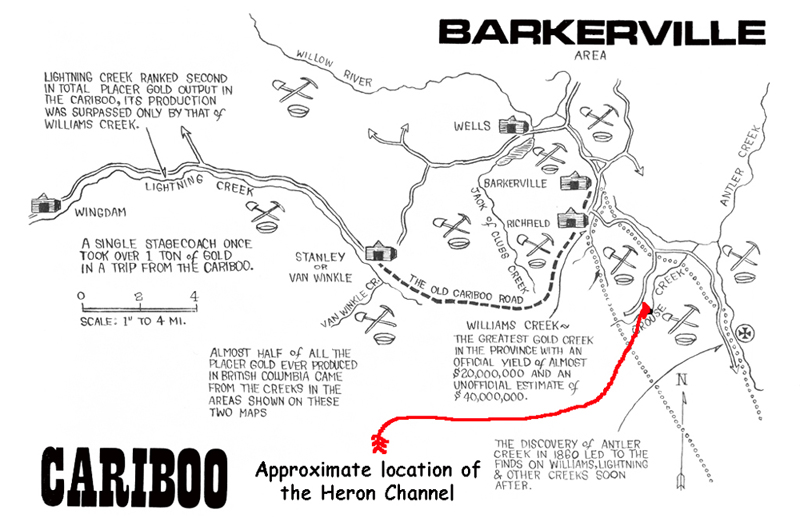
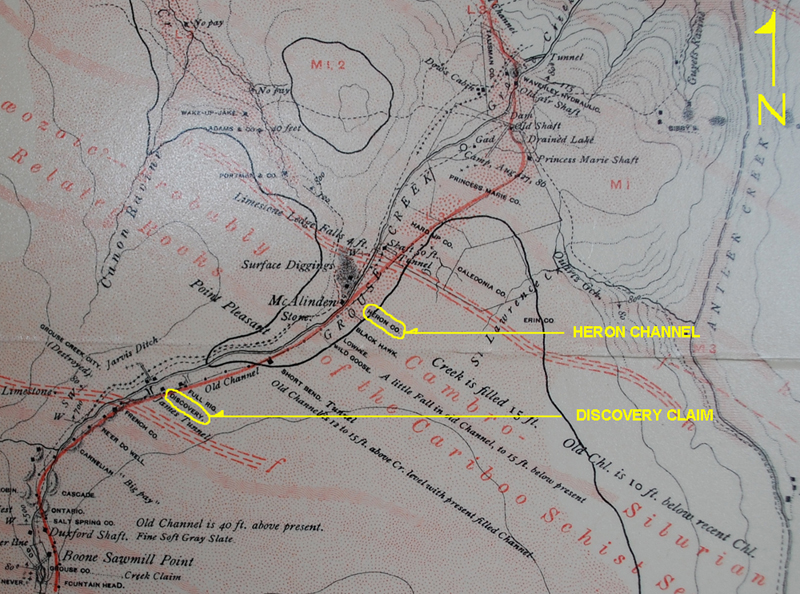 Shown here in detail is a section of Grouse Creek taken from the old Amos Bowman maps. Circa 1885-6
In the fall of 1860 George Weaver and Doc Keithley first climbed the steep southern slopes of the mountains range running down to Cariboo Lake to discover the great plateau and headwaters of Antler Creek running north. When they returned to Keithley for more supplies the word was soon out and by the spring of 1861 there were a number of claims staked along Antler as well as other parallel streams running northward – one of them being Grouse Creek. The first and most notably finds was the Discovery Claim which yielded a phenomenal amount of gold. Nearby a small settlement grew up along the sidehill next to the creek which the locals proudly called Grouse Creek City. It consisted of cabins and a store but as fate would have it for so many of wooden towns of the day most of it eventually succumbed to fire.
By 1864 the creek was being seriously explored. An American by the name of Robert Heron, while doing exploration work about a half mile downstream from the Discovery Claim, unearthed what he thought was an old pre-glacial channel running parallel with the bed. Heron and his partners then proceeded to take out over $300,000.00 in gold. At the time gold was running around $28.00 an ounce which meant Heron would have found at least 10,715 ounces of the precious metal. At today’s price for gold ($1824.00) this would translate into a profit of over $19,500,000.00. Not bad for a season’s work.
Having decided that the channel was worked out Heron sold it for $4000.00 and left the creek. The new owners formed the Heron Company and while doing further exploration discovered that the previous owner had shorted himself in more ways than one. A foot and a half below the original workings the new company discovered rich gravels that produced from 80 to 100 ounces of gold a week throughout the season.
By 1867 the Heron Company had found even more sections of this now famous channel, in particular one known as the Jimmy Allen tunnel which in a distance of 400 feet and along a narrow span of less than 8 feet yielded $750,000.00 worth of gold! Again, by today’s standards that would equal approximately $49,000,000.00 in gold.
As for the Grouse Creek War it centered on this same area wherein the Heron Channel was found and was, in the words of Fred Ludditt, “the most contentious mining dispute in the Cariboo” in 1867.
Because of the narrowness of the Grouse Creek valley in the area around the Heron claim which caused severe water problems for operations the Heron Company procured a franchise to build a several hundred foot long flume to divert the creek flow which, in turn, would allow the company to mine the actual gravels in the gutter of the creek channel. This at first proved to be an extremely lucrative venture that netted the company between 50 to a hundred ounces of gold each day but it also attracted others whose intentions were anything but honorable. Another outfit called the Canadian Company decided to stake right over the Heron property and then commenced to enforce their suspect actions by literally forcing the Heron Company employees to vacate the premises. When the Gold Commissioner, Henry M. Ball tried to dissuade the Canadian Company by swearing in about 25 constables to evict the interlopers they were met by a force of around 400 armed men who refused to leave the creek.
Eventually Ball had to wire the Governor of the province, Frederick Seymour, after further appeals to the Canadian Company fell on deaf ears. The Governor and his entourage arrived in Richfield on August 7, 1867 and met with the warring factions but in the interval between all the legal wrangling the Canadian Company was hellbent on high grading as much of the gutter gold as they possibly could. Seymour’s attempted resolution fell far short of justice and left a sour taste in mouths of the local residents who felt the Governor had sided more with the miscreants than the Heron Company. Eventually Seymour appointed a special commission to settle the dispute which finally saw the ground returned to Heron Company along with $3,600.00 in gold (likely but a small portion removed).
 Governor Seymour and his party, including Judge Matthew Baillee Begbie, Colonial Secretary, Arthur N. Birch and Chief Commissioner of Lands and Works, Joseph W. Trutch, in the Cariboo at the time of the Grouse Creek War, 1868. F. Dally photo
____________________________________________________________________________________________
According to Ludditt the total estimated production of gold from Grouse Creek was around $4 million. Today that would be the equivalent of 140,351 ounces now valued at $256 million! A goodly sum indeed.
Due to such phenomenal profits as these are born legends and as word spread about the fabulously rich channel which became known as the Heron Channel hundreds of new miners travelled to the area in the hopes of finding other sections of the elusive pre-glacial paystreak. But elusive as it appears to be today the modern-day Heron’s are still searching and seeking it out with their 21 Century technologies and equipment, determined to match or even better the gold seekers of old.
This of course is where Rick Mason, Mine Manager for Hard Up Mining Ltd, an Alberta corporation, appears on the Grouse Creek stage.
Likely no better example exists that personifies the old expression ‘man’s reach should exceed his grasp’ than what we are witnessing today in and around the old Heron Channel on historic Grouse Creek. For the past year or more Pete Wright’s Devlins Bench Mining Ltd in conjuction with Hard Up Mining Ltd have been seriously busy stretching the long arms and buckets of their excavators deep into the hundreds of thousands of cubic meters of overburden along Grouse Creek in order to remove and uncover still further, unfathomed portions of the famed and fabulous richness of the pre-glacial Heron Channel.
 Photo: Devlin Bench Mining Ltd
Aerial view of the Grouse Creek Mine site in 2010 showing settling pond on the right.
 Photo: A. Topham
Rick Mason, co-owner of Hard UP Mining Ltd observing approaching truck loaded with pre-glacial gravels.
In a visit/interview to the mine site along with Chris Winther, President of the Cariboo Mining Association, in late July, 2011 Rick Mason explained to us the plans, workings and gargantuan efforts thus far exerted to literally move mountains of overburden (non-goldbearing material) in order to unveil the pre-glacial gravels along Grouse Creek.
As Rick put it, “We’ve reached what is likely the beginning of the most interesting stage of the exploration work thus far. The data that we’ve been able to put together indicates that there’s still around 2,400 feet of virgin pre-glacial channel left to be mined and given the fact that back in the 1860s the Heron Company took out $63,000,000.00 worth of gold from just 400 feet the prospect of an additional 2,400 feet of the same gravels is rather exciting.”
 Photo: A. Topham
Rick Mason heading down toward the spot where the old 1960s workings are being exposed after 150 years.
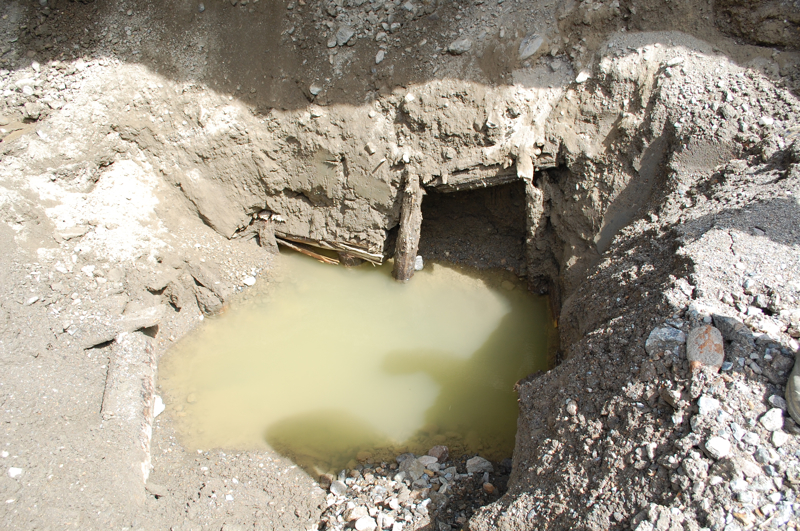 Photo: A. Topham
Here one sees the remains of the old drifts that were dug into the east bank perpendicular to the creek bed.
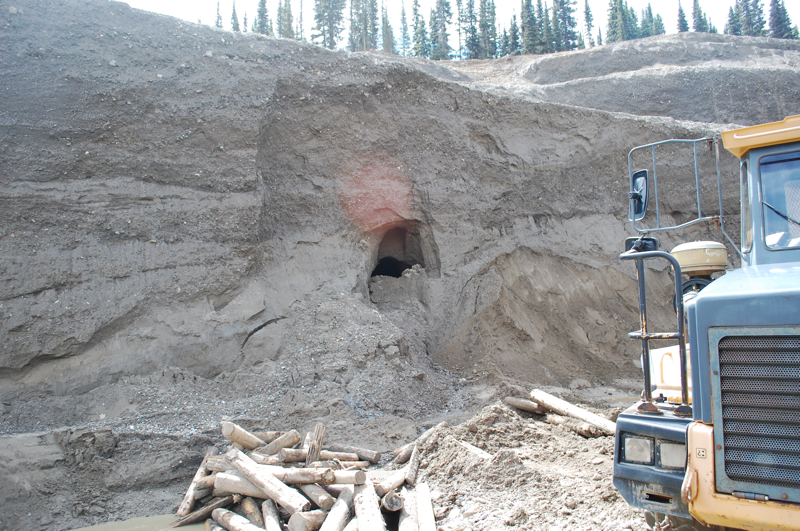 Photo: A. Topham
Exposed drifts dot the high bank of overburden. Below are strewn the round timbers that once held the drifts in place. These timbers are as solid today as they were when first installed a century and half ago.
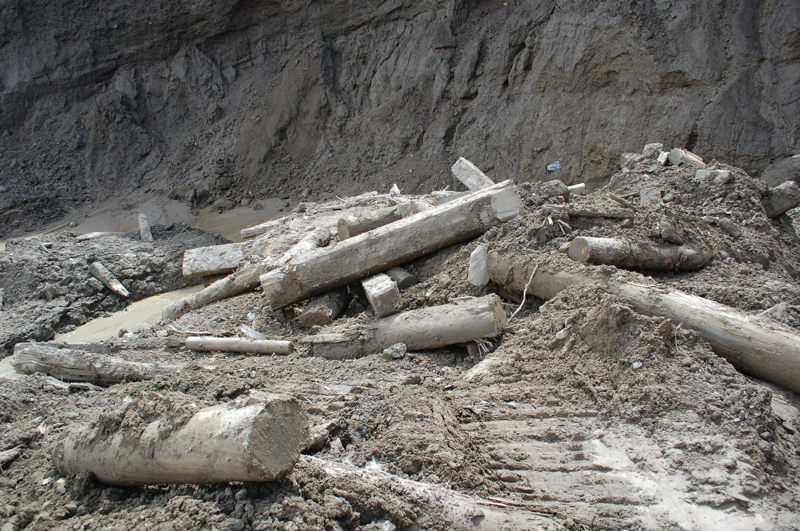 Photo: A. Topham
A close up of the old drift timbers. In the 1960s when a portion of the drifts were refurbished all the timbers used then were squared indicating that they weren’t part of the original workings from the earlier period.
 Photo: A. Topham
Again we see the old drift at the furthest point of excavation to date. Water and slum material continually leak forth from the old tunnels.
 Photo: A. Topham
Chris Winther, President of the Cariboo Mining Association in discussions with Rick Mason. Behind is the backdrop of sheer clay and rock overburden that at one time in the past presented an insurmountable obstacle to the placer miners of old. Today, thanks to modern machinery, these challenges can be met.
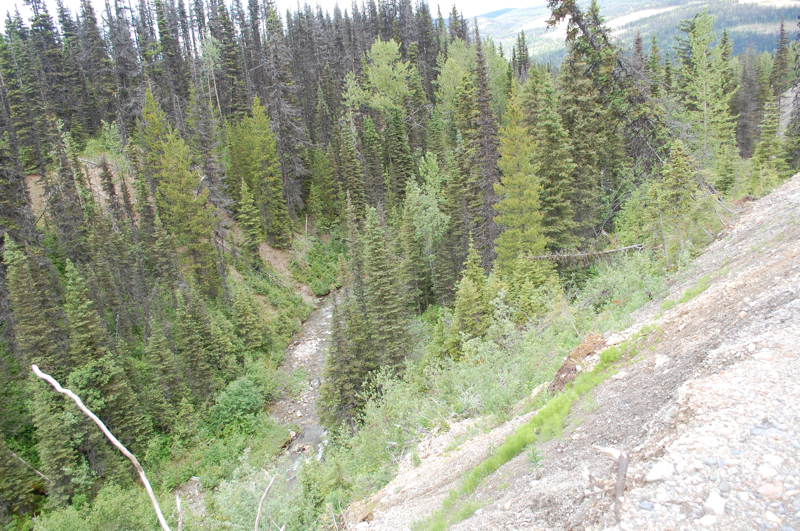 Photo: A. Topham
The steepness of the banks running down to the present day Grouse Creek are visible in this photo.
 Photo: A. Topham
Once again we see the high banks of overburden behind Chris and Rick who are near the upper reaches of the workings on Grouse Creek.
 Photo: A. Topham
The view here is looking up Grouse Creek toward the famed Heron Channel. Presently Hard Up Mining Ltd has about another 600 feet distance to go before reaching their destined goal.
 Photo: A. Topham
Remains of the old track running into one of the many drifts along Grouse Creek. This bit of history is now held in place by the riparian zone that skirts Grouse Creek on either side for a distance of 10 meters.
 Photo: A. Topham
Looking downstream to the wash plant and camp headquarters and beyond toward the Bowron Lake Park the magnitude of the project becomes only that much more prominent and apparent.
 Photo: A. Topham
The iron (equipment) required to process the volume of pay dirt is costly and expensive to operate but without it the chances of ever recovering the remaining sections of the Heron Channel would be impossible to fulfill.
In their business prospectus for Grouse Creek one can read about the early history of Grouse Creek and how due to the “Grouse Creek War” the ground in and around the famed Heron Channel eventually was turned into a Crown Grant. These Crown Grants issued by Queen Victoria virtually guarantee the property owner, “absolute estate in fee simple, the most powerful real estate clause in existence. Today, Crown Grant 13f is one of only a half dozen remaining Crown Grants issued by the Queen in the 1800’s, and a powerful development tool for mining investment.”
Over the years the properties in the area exchanged hands but the owners were never able to muster the material wealth to tackle the project now underway. In 2009 Devlin’s Bench Mining Ltd purchased the ground and since then, along with Rick Mason and Hard Up Mining Ltd, has been pursuing the lore and the lure of this stunning project. Placer miners everywhere are sure to appreciate the scope of this project and I’m certain that everyone is keeping their fingers crossed that before too long those long arms will eventually uncover yet another dream and turn it into a modern day Cariboo gold fields reality.
———
For more information about Grouse Creek, or Devlins Bench Mining Ltd. contact:
Pete Wright
General Manager
office: 250-994-3338
email: wrightcontractingltd@gmail.com
Business inquiries:
Dave Jorgenson
Site Manager
office: 250-994-3338
fax 250-994-3247
email: dave@williamscreekgoldfields.ca
Minesite:
250-994-3337
Links:
http://williamscreekgoldfields.ca/grouse_prospectus.pdf
NRA: Goals for Immediate Firearms Legislation Reform
 http://www.nfa.ca/goals-immediate-firearms-legislation-reform
Goals for Immediate Firearms Legislation Reform
• Completely repeal the former bills C-17 and C-68, known as the Firearms Act—including scrapping the firearms registry, firearms licenses, and destroying the records.
• Eliminate firearm licences and the requirement to take any sort of course to own one’s own property; ordinary firearms owners are not a threat to public safety, violent criminals are.
• Eliminate the automatic check of legal firearms owners when a person is stopped for a traffic offence and replace it with an instant check of criminal/parole/probation records; hunters and target shooters are not a threat to public safety – violent criminals are.
• Replace the licensing and registration provisions with a point of purchase instant criminal record check for firearms. This system would keep legal access to firearms away from criminal elements by making use of a practical list of people who should not have firearms, rather than by trying to make lists of those who may.
• Renounce the agreement to implement the UN marking regulations (Firearm Markings Regulation SOR 2004-275) that was passed in 2004.
• Cancel the introduction of the proposed new gun show regulations.
• Curtail the RCMP’s attempts to unilaterally reclassify firearms.
• End prohibitions on magazine capacity.
• Restore handgun hunting as a legitimate use of a handgun.
• Eliminate punitive safe storage and transport requirements that have caused much grief to firearm owners in the absence of any wrongdoing.
• Remove the category of prohibited from firearms ownership so as to allow free exchange of property. The arbitrary nature of the prohibited class is a great affront to ordinary citizens who happen to own these firearms. It is also a means of stealing their property from them as many prohibited category firearms may not be passed on to heirs, or readily sold at their fair market value. If there is to be a “restricted category”, then it must have broader reasons for use, which should allow combined reasons for ownership and use, and it must include at least hunting and self-defence along with the other categories.
• Encourage support for recreational and competitive shooting sports so as to eliminate the negative stigma created by this regressive legislation.
—————–
Mineral Tenure Act Regulation – Proposed Amendments Summary Report 2011

Mineral Tenure Act Regulation – Proposed Amendments Summary Report 2011
Table of Contents
1. Executive Summary…………………………………………………………………………………1
2. Background…………………………………………………………………………………………….3
3. Discussion………………………………………………………………………………………………5
4. Next Steps……………………………………………………………………………………………….9
5. Appendices:
i. Consultation Process………………………………………………………………10
Executive Summary
Discussions between the former Ministry of Energy, Mines and Petroleum Resources (the Ministry) and the mineral exploration sector (industry) have revealed that a balanced fee structure, affordable to both the individual prospector and company (Junior, Senior and Major) is necessary to promote further mineral exploration in British Columbia.
Eleven (11) mining associations and organizations submitted feedback to the Ministry via face-to-face meetings with Ministry Titles staff and a 73-day industry comment period in the fall of 2010. Participants were asked to provide input on proposed amendments to the Mineral Tenure Act Regulation, including a new fee structure and revised annual exploration work requirements (claim maintenance). In total, 117 industry representatives participated in information sessions and 25 submitted additional feedback by email during the comment period.
The majority of feedback mirrors consultations held with industry in 2008 and reflects the primary goals of the amendments, which are to:
1. Increase the efficiency of the current mineral subsurface tenure process;
2. Increase the amount of mineral land available for actual exploration and development; and
3. Update the fee and work requirement structure to align with current industry exploration costs.
Key findings from the consultation include:
• Restricting the use of cash in lieu, in addition to proposals to double the fee payment, was strongly supported by industry.
• The majority of industry representatives were in favour of a yearly staged increase for the exploration work requirements (mineral) but felt that the initial two years and years eight and beyond needed to be lower to allow individual prospectors and smaller companies to prosper.
• Industry representatives were in agreement with increasing the claim registration fee for both mineral and placer development but felt that current proposals ($1.75/ha and $6.00/ha respectively) were too high.
• No consensus was reached regarding proposed increases to lease rental fees; however, the general perception from industry was that the jump from $5.00/ha to $20.00/ha for placer development was too high and not comparable to proposed increases for mineral lease rentals (from $10.00/ha to $25.00/ha).
• Approximately 50% of industry participants recommended a revision of the proposed Portable Assessment Credit (PAC) fee increase and utility without specific suggestions.
• Increases to the maximum production limits for placer activities were endorsed by industry, with recommendations to make legacy and claim amounts equivalent.
• Overall support was received for eliminating the work registration fee, increasing the maximum claim size, and increasing administrative fees.
• A number of out-of-scope issues and recommendations were identified by industry, including the need for a more streamlined permitting process; improved services from
the ministry with respect to inspections, permitting and titles acquisition and maintenance; greater support and incentives for current and future mineral explorers; education and training on applications, sampling procedures, and consultation requirements; and further review of Mineral Titles Online.
Response to CMA article: Rumours, Rumblings & Rock Hard Resistance
[Thulefoth, a member of the Pre-loved Placer Forums, has replied to the article below which was posted on the Pre-loved Placers Forum. I am posting it here on the CMA site as I feel it has relevance to the ongoing discussions that took place during the meeting held with MLA Bob Simpson. Webmin]
Re: Rumours, Rumblings & Rock Hard Resistance
Reply #1 on: March 18, 2011, 06:13:40 PM from “Thulefoth”:
Quote from: ArthurTopham on March 16, 2011, 12:06:05 PM
“… the general public perceives placer mining as an environmental threat and associates the behaviour and actions of small, independent miners with that of the big hard rock mining consortiums who tend to always capture the media’s attention with their giant projects that inevitably raise public concerns about environmental damage.”
Well, sure, once someone internalizes that what small miners do in the creeks constitutes an offence from certain philosophical viewpoints, then opponents will try to tar them with any other brush that’s handy. People who oppose the activities of small miners, then seek to link them to other actors who are suppose to be bad, too (corporate mining) … whether there is really any relationship or not.
On the one hand, California just ‘suspended’ all dredging. Other West Coast states have already gone through the dredging re-evaluation process, though, and it seems likely that California will align with their Ecologically informed rules, and reinstate dredging within not-too-long.
But on the other hand, events & trends in the USA are not going favorably for Enviro Activism. Long called a ‘Silent Majority’, important components of the vaguely small-c conservative population have been wrenching the US political scene in unusual ways.
Anthropogenic Global Warming reliably ranks Dead Last in a list of a couple dozen Issues that folks are polled on. Al Gore is a crazed sex poodle. Science has been reduced to consensus.
The Baby Boomers are aging. Wealth is fleeing. Security is evaporating. Global competitors are becoming actually competitive. These factors and more serve to shift the overall outlook of the country toward the pragmatically conservative. It is a reasonable guess that this is a long-term trend.
The idea that loggers are all but Untouchables, that clubbing a halibut on deck can be used to hurt you politically, that PETA is a legitimate voice on Farm Policy, and that small scale placer miners can be painted as Desecrating the Sanctity of Nature – are all assumptions that no longer appear to be in the ascendancy.
Canada traditionally puts more emphasis on Provincial & local authority, than on the Federal. The US strived for much of the 20th C. to hulk-up the role of the Fed, but now there are strong signs that this experiment is being dialed back.
Federal domination works through the distribution of tax moneys, and that distribution network deals with State & Provincial government & capitols, and especially with Big Cities.
As we watch Federal ‘payola’ systems wane & wilt, the system in which big cities rake in the cash purely & simply because they are big cities, will lose momentum. Cities will have to make decisions in a much more down-to-earth and business-like way, instead of putting on a song & dance for predictable hand-outs.
Cities are the bastion of both individuals and Philosophies that can’t club halibut, couldn’t turn trees into lumber, and won’t wash gravel down at the creek. These constituencies appear on-track to become, while perhaps not Endangered Species, at least diminished & displaced within the political ecosystem. Big Cities have long been our biggest & worse chronic welfare recipients … and they – and their Philosophies – will change as they are weened off the public purse.
The bottom line is, that although British Columbia will have Parks that preserve some stands of Old Growth timber, and there will certainly be mining regulations for both the large & small players – BC is wealthy in natural resources and needs to avoid getting sweet-talked or harangued into cutting off its nose to spite it’s face.
Trends in North American popular & political culture, and in the larger global context, support that going forward BC can & will strive to safeguard mining & miners. And loggers, and halibut-clubbers.
Ted
—————
Rumours, Rumblings & Rock Hard Resistance
 CARIBOO NORTH MLA BOB SIMPSON SPEAKING TO CMA MEETING
Rumours, Rumblings & Rock Hard Resistance
CMA Monthly Meeting with Cariboo North MLA Bob Simpson
By Arthur Topham
CMA Webmin
March 13, 2011
The regular monthly meeting of the Cariboo Mining Association, held at the Quesnel Senior’s Center on Sunday, March 13th, featured Cariboo North MLA Bob Simpson, former representative of the NDP party and now sitting as an Independent in the B.C. legislature.
Bob was attending the meeting at the request of the CMA membership who are striving to find ways to deal with upcoming bureaucratic changes within the provincial government ministries affecting placer mining in the Cariboo region.
Attendance was good and interest high as CMA President Chris Winther introduced Simpson to an audience of placer miners eager to hear further news on some of the upcoming proposals and changes to ministries directly responsible for mining and exploration in the province.
Topping the list of concerns were questions regarding the new Ministry of Natural Resource Operations and how the proposed power structure will take shape and deal with issues of leases, cells, tenure management, First Nations, and, foremost for many of the placer miners in attendance, fee increases of such proportions that they threaten the very survival of the small operators.
Government de jure
Simpson prefaced his comments on all of these issues by doing his best to enlighten the audience about the present political situation in Victoria following the change of guard within the Liberal government’s leadership and pointing out that until noon on Monday, March 14th (which would be the day after the meeting) when Premier-elect Christie Clark was to announce to the province her government’s upcoming agenda, it was virtually impossible to know who and how the relevant ministries would be dealing with placer miners and their concerns.
What was clear, according to Simpson, was the reality that government at this stage was in a state of complete flux and disarray and any and all of the backlog of proposals, permits and possibly impending legislation formerly being discussed were all subject to this confusing scenario now unfolding in the political arena of the province. If Clark announces to the house this coming Monday that an election is not happening until 2013 then that will affect the mining industry in one fashion but if an election is going to pre-empt the reorganization of the ministries involved then that will essentially block any possible progress over the coming months ahead in terms of resolving the issues that placer miners are struggling to get answers to now.
Images
The present negative image of placer mining in the province was voiced again by those present and the argument put forth that due to a number of misconceptions on the part of the news media, who inevitably are unduly influenced by some of the more strident environmental groups in the province and coupled with First Nations concerns, the general public perceives placer mining as an environmental threat and associates the behaviour and actions of small, independent miners with that of the big hard rock mining consortiums who tend to always capture the media’s attention with their giant projects that inevitably raise public concerns about environmental damage.
Simpson was quick to agree that this image problem was definitely a clear and present danger to the small operators who are and have been working for years now under very strict guidelines and regulations that ensure a minimal amount of environmental disturbance relative to the major corporations who tend to dismantle mountains rather than move mere cubic meters of pay dirt and overburden. And in this sense, Simpson stated, the ecological footprint left by the small placer miner and their operations is barely noticeable relative to larger mining companies yet the image of possible impending environmental damage of vast proportions tends to stick in the public’s mind and override the facts surrounding the actions and effects of the smaller operators.
Examples of this, according to Simpson, are two major gold mining operations located in the Cariboo at Mount Polley and Gibraltar.
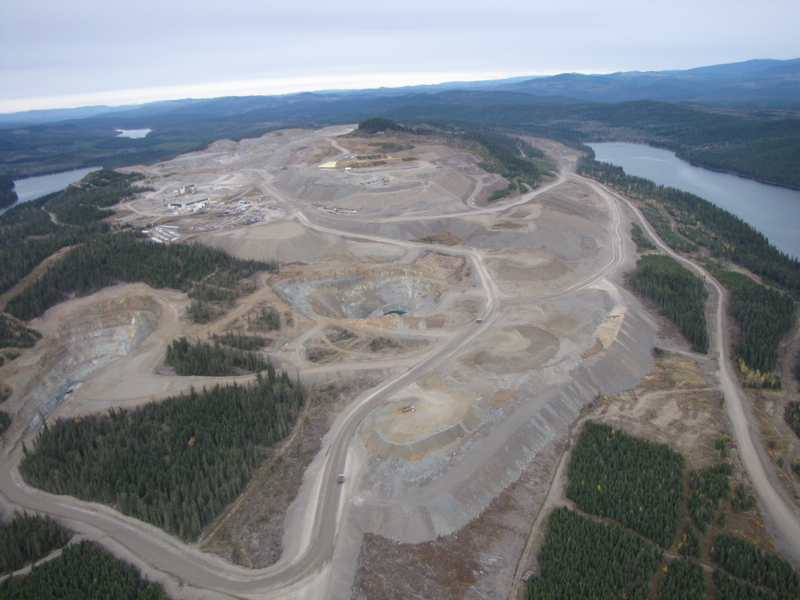 PHOTO: JOHN BOT MOUNT POLLEY MINE NEAR LIKELY, B.C. (QUESNEL RIVER WATERSHED)
 PHOTO: JOHN BOT GIBRALTAR OPEN PIT MINE (FRASER RIVER WATERSHED)
Initially these mines were legislated to operate in a manner that precluded the discharging of any effluent that might negatively effect either the Fraser River or Quesnel River watersheds where these operations are now in place. Recent changes and updates plus added investment dollars have increased former levels of production resulting in the companies’ recent applications for permits that would allow additional discharge of material outside the former containment areas. Whether these permits will meet the approval of both the provincial and federal governments waits to be seen. Should they go ahead the footprint left will again be of a much larger scale than anything the small placer miner will be leaving behind. If the changes prove to be environmentally sound all will be okay but should problems arise the placer miner will most likely also bear the burden of any negative publicity.
How to counter such problems should they arise becomes an added burden for the placer miner on top of dealing with all the other legislation and ministerial changes in government.
The feds
The issue of federal fisheries and their impact on placer mining operations in the Cariboo was also raised, with Simpson wholeheartedly agreeing that the fed factor is clearly problematic when it comes to placer mining. Specific to this discussion were concerns about specific areas in and around Likely/Keithley Creek where CMA members are dealing with land use issues surrounding the opening up of ground that currently restricts placer miners from operating yet allows major forestry companies to log and also gives the hard rock mining industry access to do drilling and exploration work.
Part of this discussion included Simpson remarking on the 2003 Task Force document that was produced by the provincial Liberal government which apparently covers issues like what is occurring in the Likely region. Chris Winther, CMA President, pointed out that he was unable to access the information contained in the document and Simpson added that it was deemed a “Cabinet Report” and therefore, by definition, inaccessible to the public and beyond the scope of even the Freedom of Information (FOI) act. Obviously the audience was not impressed by this refusal to withhold information affecting their ability to mine in areas where the big boys are given free rein in the sandbox yet they were being told they couldn’t explore or mine.
First Nations
A further conundrum voiced during the meeting, for placer miners who, for the most part, are small operators working within already strict government guidelines and under continual financial pressure, was the question of First Nations and how the small placer miner is to deal with the bureaucratic nightmare that has resulted from the province’s and the fed’s apparent inability to deal with one of the most fundamental and basic land use problems – the resolution and final settlement of the Treaty issue with the former owners of the province’s land and natural resources. As Simpson went on to explain it’s an issue of primary concern to all the players involved and due to the fact that the provincial and federal governments have not addressed and settled it the haunting effect tends to override every decision on land use management and play a major role in how the placer miner is caught up in the problems and unduly affected by them.
As a number of members pointed out to Simpson respecting this spectre of added red tape, they don’t see it as being their personal responsibility to deal directly with yet another level of government in the form of further First Nations bureaucracies. They felt that the regulations put in place should be such that when they apply for licenses or permits or mineable ground that they deal with the appropriate provincial mining ministry rather than having to also represent themselves individually to each and every First Nations group that wishes to have a say in their placer operations.
Simpson did his best to explain how and why the problems arose and at the same time tried to explain to the obviously disgruntled audience that it wasn’t necessarily all a negative thing that First Nations were demanding a voice in the management of lands which they had, in actuality, never ceded to the provincial or federal governments. He went on to explain how he had visited a number of different areas of the province where the native bands were working in partnership with different mining interests and cutting deals that turned potential conflicts into win-win situations for all parties concerned. Whether or not these agreements were comparable with those of smaller, individual placer miners wasn’t clarified but the point that Simpson appeared to be making was that there was a certain degree of responsibility that the placer miner had to recognize as being his or hers and ultimately it might prove profitable in the long run for placer operators to take on this aspect of negotiating on their own behalf.
Rumours of fees
The ongoing discussion regarding fee increases for placer miners was also brought up for Simpson’s consideration and comment. Again he cautioned the audience that due to the turmoil and confusion at the present time and also due to the rather nebulous and shady manner in which the former Campbell government arranged the province’s financial books, fighting against and justifying the increases won’t be a simple task. Revenues generated by the placer mining industry have been funneled off like larger aggregate in a screened shaker plant and deposited surreptitiously in other budgetary bins that tend to disguise their whereabouts and origins and make them susceptible to manipulation for political purposes, thus posing difficult problems for the small operator who expects transparency when it comes to government demands for more and more fee increases. Simpson’s basic message was that until we know the direction and the schedule of the present government and are able to identify all the new players within the various ministries responsible it will be virtually impossible to get answers to these questions but once things have settled down and the high water run-off from this latest political storm in the province subsides, we can then proceed upon the only reasonable course left, that of lobbying directly for changes that the placer miners of the province can live and work with.
Ministries of DoubleSpeak?
A final topic of discussion brought to Simpson’s attention by CMA President Chris Winther was that of the closing of the province’s mining offices. Given the fact that the Cariboo Mining District is the largest and richest gold producing area of the province Winther felt that shutting down the government’s mining office in Quesnel was counter-productive and placed a number of additional burdens on the placer mining industry that once functioned quite well under the old system. Simpson responded by saying that under the new proposals being implemented by the Liberal government it was virtually a dead issue that ANY mining offices anywhere in the province would be left in existence. The closest placer miners could expect to such a government office would be the new venues known as “Front Counters.” Like the government’s “Service, B.C.” outlets now found in every provincial building the names change and any direct encounter with government agents who can address local, immediate problems, becomes more and more impossible to achieve. It appears to be all part of the new DoubleSpeak that affects government bureaucracies at all levels these days.
The best that we can hope for is a “Front Counter” in Quesnel Simpson stated and from what he had heard this latest bureaucratic shuffle may place the dance floor in the former Forestry Offices building in another part of town where they too are experiencing the bungling effects of impending bureaucratic changes.
The meeting culminated in a discussion about ways and means of lobbying the various levels of government in order to gain answers to all the unresolved questions that originally prompted asking Bob Simpson to attend the CMA meeting in the first place. Once again Simpson advised the audience that until the political upheavals of the day settle down and heads of ministries were in place it would be fruitless to expect any changes. Afterwards though will be the time to begin educating the bureaucrats about the concerns expressed at the meeting. Mention was also made that the CMA’s new website was a valuable tool in helping to communicate the concerns of the placer miners in the Cariboo and would undoubtedly prove useful in the long and lonely lobbying process ahead. Ultimately, it appeared, the CMA is being forced by factors beyond its immediate control into playing the waiting game along with the rest of province.
Time, we hope, will resolve these issues. A hearty and encouraging show of appreciation for Bob Simpson’s advice and comments was given at the end of the meeting and the CMA looks forward to more positive dealings with the MLA in the days and months ahead.
————————
Polarities by Celine Duhamel, Director C.M.A.

Polarities
By Celine Duhamel
Director, C.M.A.
On our last holiday away from the snow I found myself at a birthday party being introduced as a prospector.
Right away a fellow next to me admitted to having a claim and with a smile said he was protecting it from being mined. He also continued on about how great it was for camping.
I thought to myself here we go again. He’s obviously putting me on the wrong end of the debate over the environment vs mining issue and trying to portray himself as its savior.
So I replied that yes in the past there have been miners that left messes but that now we are held accountable for what we do by a lot of government regulations which require reclamation of disturbed ground and that things have changed from what they used to be in the “old days.”
He then proceeded to tell me about someone he knew who dredged. I replied that I knew of only a couple of places in B.C. where it was still allowed and they were not where he mentioned. I asked if this fellow had a free miner’s license. He said yes but later remarked that he doubted it.
He was still interested in dredging so I told him that for us we could not mine within 10 metres of the flood plain of a creek and that in any case there should not be any visible sediment entering the stream. He was surprised by this information.
So here you have it folks right from the trenches. A person with a free miner’s license and a claim but still ignorant of mining regulations and on his high horse spouting off negative misinformation on mining for all who’ll listen. I would bet money that he wears precious metal jewelry, owns a cell phone, a computer (with gold components) and perhaps even some gold crowns.
Like most placer miners, I realize that the environment is in distress and I like to think that I’m doing my part for the betterment of the ecology. Similarly we share the enjoyment of nature; but what I am concerned with is how miners are perceived by the general public. It is not the first time I have come across “nuisance stakers”, and there is no sense ranting and raving to them. I am hoping that in the future we can inspire trust by the way we do our mining.
Join the C.M.A. if you find that these principles fit your own. The advancement of our association does not rely on any one person but on all of its members. There is a need for a place where we can voice our opinions and perceptions to become a unified force in today’s society.
Thanks for listening.
Celine Duhamel, Director C.M.A.
Taseko’s Prosperity mine “dead issue,” say Indians

Taseko’s Prosperity mine “dead issue,” say Indians
Taseko Mines Ltd (C:TKO)
Shares Issued 187,745,853
Last Close 2/23/2011 $6.16
Thursday February 24 2011 – News Release
(Article submitted by John Bot)
Chief Joe Alphonse of TNG reports
TASEKO MINES LTD PROVES IT ONLY CARES ABOUT MONEY – NOT THE ENVIRONMENT OR RIGHTS
Taseko Mine’s Ltd. is playing costly and dangerous games with first nations and all British Columbians in its cynical attempt to revive its so-called Prosperity mine, the Tsilhqot’in National Government said today.
“This latest move would be laughable, were the issue not so serious,” said TNG Tribal Chair Chief Joe Alphonse. “Enough is enough. It is time to put an end to this company wasting everybody’s time and resources on a project that most now realize is a dead issue.
“This latest move by the company leaves little doubt now that its plan all along was to get the cheapest project it could. Now it is desperately trying to find any way it can to revive this project regardless of its impact on the environment and our First Nations rights,” Chief Alphonse said.
“We commend the federal government for seeing through the company’s claim and rejecting its first plan – which the company was told for 17 years was not acceptable – and we also commend Prime Minister Stephen Harper for standing firm on that decision this week,” said TNG Xeni Gwet’in First Nation Chief Marilyn Baptiste.
“Hopefully the federal government, the soon-to-be-elected new provincial premier, and the public will quickly make it clear to Taseko Mines Ltd that this nonsense must end,” said Chief Baptiste.
The latest move by Taseko is so cynical and fatally flawed that that it is hard to see how anyone can take it seriously, Chief Baptiste said.
The company has not consulted with First Nations or the public and it has kept the details secret. It continues to pretend that there is only one issue – the protection of Teztan Biny (Fish Lake) – that needs to be addressed, when the CEAA review panel report and the federal government’s own conclusions made it clear there was numerous and “scathing” problems with the project.
“It seems to think it can insult governments and the public by treating us all as fools with short memories,” said Chief Baptiste.
“This company categorically insisted that – even with soaring gold and copper prices – its first proposal was the only economically viable one. It also categorically insisted that any other options for the project would be even more devastating to the environment and First Nations rights,” said Chief Alphonse.
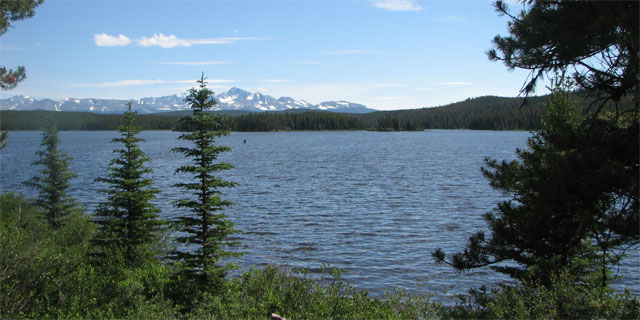 Fish Lake in the Chilcotin. Taseko’s first proposal included eliminating it.
_________________________________________________________
“Yet within weeks of its proposal being rejected last November 2, it claimed that it could now suddenly afford to go with an alternative that saved Fish Lake, and it is now hoping that everyone will forget that both it and the CEAA review panel report made it clear last year that any alternative to the original plan would be an even bigger disaster.”
Taseko’s new move is costly because it will force governments to spend tax dollars dealing with a clearly unacceptable bid, and could even see the province continue to pump tax dollars into promoting this project on Taseko’s behalf.
It will also force First Nations, who have been on the front line of defending the land against this project, to continue to spend scarce resources that would be better spent on pursuing genuine and sustainable opportunity.
One also has to wonder how excited investors are about the company adding to the $100 million it has already wasted pursuing this doomed project over the last 17 years.
The rebid is dangerous because it seeks to avoid having another full review of the project and have governments accept the new plan as addressing all concerns. If it were to succeed, it would mean the strong federal EA process would be taken over by the weak and industry biased provincial process.
In effect, the company is seeking to undermine the entire process and set a precedent that will give companies a way to proceed with bad projects through the back door.
The new bid also diverts attention away from the real issues facing mining in BC, and the need to reform the mining system to ensure that the industry and first Nation and other governments can work together to identify and pursue good mining projects.
“The company and supporters such as provincial Mines Minster Randy Hawes and Liberal Leadership Candidate’s Christy Clark and Kevin Falcon continue to act as if money is the only issue here.” said Chief Baptiste.
“We are particularly offended that Mr. Hawes has once again implied we are holding out for money and that he will try to buy our support with benefit agreements,” said Chief Baptiste.
“He knows full well that we will never accept this project and that for us that this is not about money. We are not willing to sell out the land, the water and our rights, future generations and way of life at any price. Period.”
———–
2011 Canjex Publishing Ltd.

 The Cariboo Mining Association