Monthly Archives: August 2011
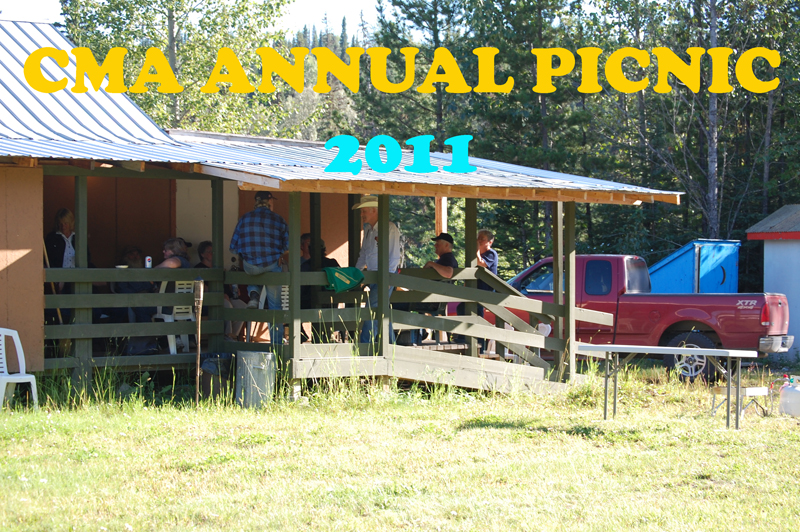
CMA holds Annual Picnic at Sunny Cottonwood
CMA holds Annual Picnic at Sunny Cottonwood
 by Arthur Topham
CMA Secretary
August 28, 2011
The weather couldn’t have been better for holding a picnic. Clear sunny skies and a shady porch to hang out in to discuss all the latest stories and adventures that the Cariboo Mining Association members have been experiencing this season made the afternoon affair a golden event indeed.
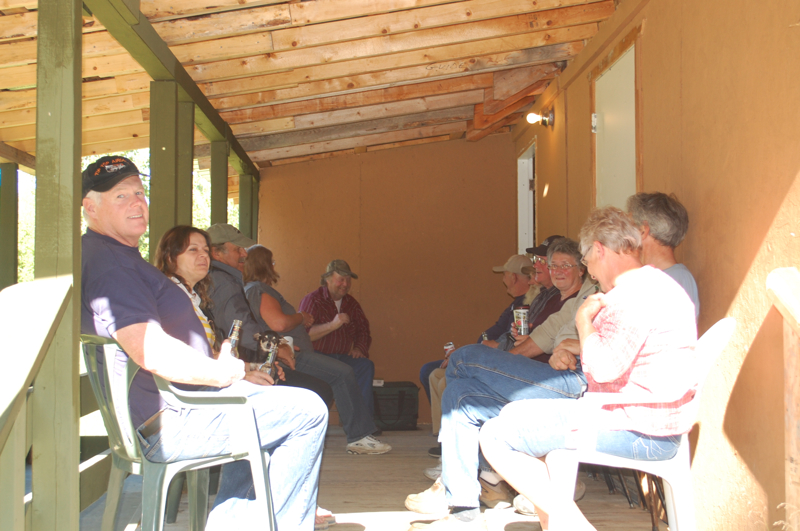 The turn out was great given that now is the height of mining season and the window for running gravels through the wash plants is wide open and people are “givin’ it” from morning to night in their efforts to run as much pay dirt as humanly possible.
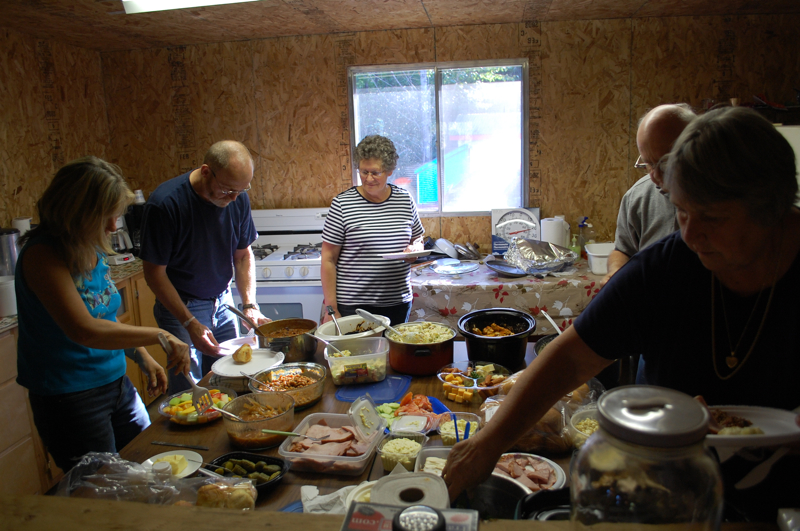 It was just as well that around forty folks showed up because the pot luck dinner was abundant and the food superb and it would have been a pity to see it go uneaten.
 CMA T-shirts, hats and Mining signs were available along with membership sign ups and of course everyone was keen to get their free red tickets for the Gold Nugget draw.
 A “CMA Claim” draw was also held in order to raise a bit of gold dust for the coffers and members were diggin’ deep to come up with their loonies.
 Miner talk was going on both inside and outside the hall throughout the event.
 Brenda Dunbar, CMA Treasurer, was most pleased with the turn out. Yahooo!!!
 Don’t you dare! says CMA member John Bot who was caught sniping goodies in the kitchen before dinner by the intrepid reporter of the event.
All in all it was a nice relaxing event as picnics ought to be and a wonderful time to hear from fellow members and find out how they were doing in their quest for the yellow metal.
A special thanks to the CMA ladies for the fine Cariboo cuisine and to the Cottonwood Community Association for renting out the hall once again and providing an evening of great country music and dancing.
—————-
The Lore & the Lure: the Grouse Creek War and the Search for the Lost Heron Channel
 The Lore & the Lure: the Grouse Creek War and the Search for the Lost Heron Channel
By Arthur Topham
Secretary
Cariboo Mining Association
Special to the Cariboo Mining Association
August 18, 2011
“I walked the streets of Barkerville
And paused along the way,
I marvelled at the ancient church
Left from that bygone day.
The rustic streets still echo strong
As in the days of old,
Where miners by the thousands came
In search of yellow gold.”
~ Betty McCrimmon, Cariboo Poet
from In Search of Yellow Gold
Some have rightly said that the Motherlode of the Cariboo’s early mining history, like the source of the gold itself, has still to be discovered; that the land of lore and legend, with its canyons and creeks and vast, unexplored valleys and crags still remains brim full with interesting and amazing tales and characters and mysteries that have been overlooked in the past half century or more.
One of those forgotten, yet actual, stories from the historic gold fields of the Cariboo region, goes back to the nascent beginnings of the famed 1860s gold rush when the area was first explored by the early gold seekers. While most history buffs will likely recall the famed Chilcotin War between the indigenous people and the colonial government that took place during the same period, if asked whether or not they also recall the Grouse Creek War or ever heard of Grouse Creek City most would undoubtedly shake their heads in a left right manner and say “no”.
Given the fact that the year 2011 marks the 150th Anniversary of the discovery of one of the Cariboo’s richest gold creeks, Grouse Creek, it’s only fitting that the story of this famed gold-bearing gorge be once again retold. But of even greater compound interest is the fact that Grouse Creek, tho’ having slumbered silently under a mountains of overburden and historic neglect, still remains a source of deep interest to present-day mining companies, very much aware of its past performances and challenges, who are busy as I type, investing even greater sums of money, time and resources in order to manifest that longstanding dream of uncovering still more of the yellow gold that the Cariboo poet Betty McCrimmon wrote about in her verse.
One of the most detailed accounts in existence of the history of Grouse Creek, its war and fortunes, was bequeathed to British Columbia by gold miner turned historian and writer, Mr. Fred Ludditt. Ludditt, who first visited Barkerville in 1930 then relocated there in 1935 from Quesnel to begin prospecting and testing the ground, had been placer mining along the Fraser River for some time but realized that he would only find fine gold along the banks of the ‘river of destiny’. He had heard the many stories about the course nuggets and heavier flake gold to be found in the Barkerville area and eventually the lure of such riches, as with so many others before him, drew him up into the the heart of the Cariboo Proper to try his luck.
Around this time there were between 200 and 300 people living in Barkerville and Ludditt and his brother settled in, fully aware of the local townspeople’s saying which Fred recalls went, “If you live in Barkerville for two weeks you are committed to it for life. This has been proved many times to be true. I, too, had not been there long before falling under the spell of Barkerville, its people and history, and of the glorious surrounding countryside.”
Those of us today having a keen interest in both mining and the history of the Cariboo are deeply indebted to the early miner/scribes and poets like Fred Ludditt and Betty McCrimmon who had the forethought, imagination and stamina to capture on paper the impressions, thoughts, words and historic deeds of earlier times. It is to Fred that I owe a note of thanks for the information on Grouse Creek contained in this article as well as to information found on Pete Wright’s website http://www.williamscreekgoldfields.ca/ .
 Old photo of Grouse Creek showing the early workings. Circa 1880s
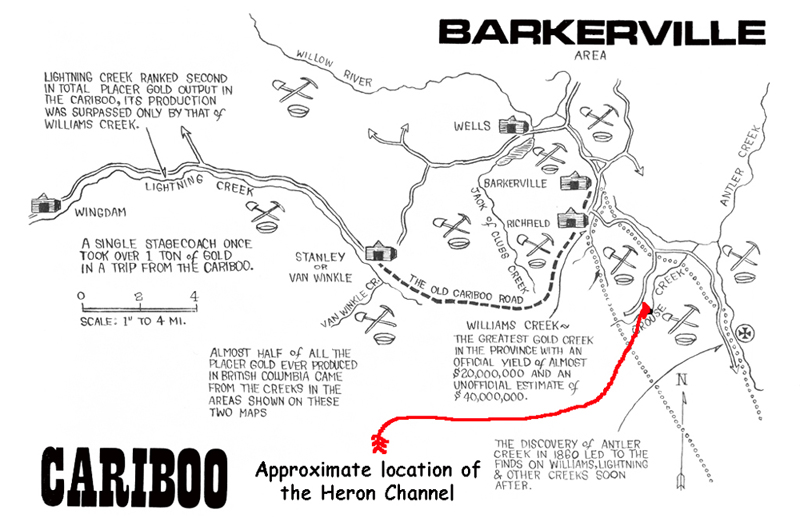
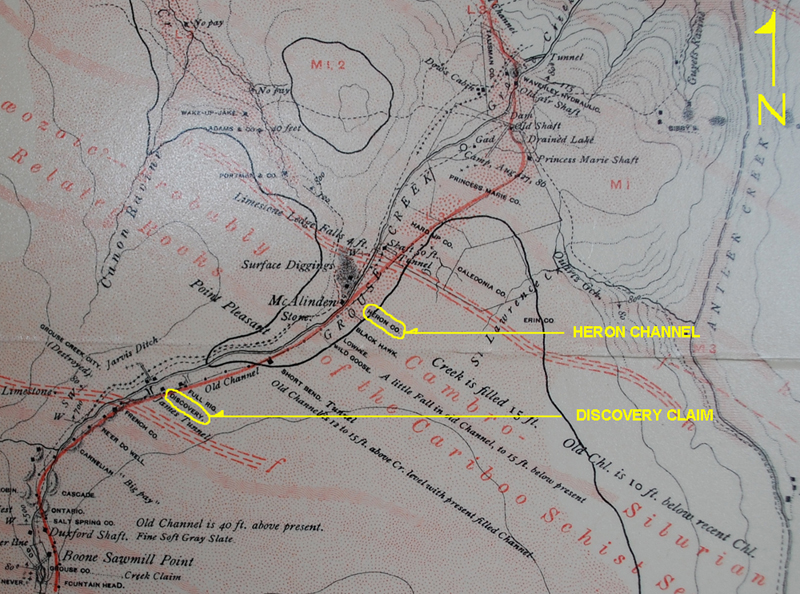 Shown here in detail is a section of Grouse Creek taken from the old Amos Bowman maps. Circa 1885-6
In the fall of 1860 George Weaver and Doc Keithley first climbed the steep southern slopes of the mountains range running down to Cariboo Lake to discover the great plateau and headwaters of Antler Creek running north. When they returned to Keithley for more supplies the word was soon out and by the spring of 1861 there were a number of claims staked along Antler as well as other parallel streams running northward – one of them being Grouse Creek. The first and most notably finds was the Discovery Claim which yielded a phenomenal amount of gold. Nearby a small settlement grew up along the sidehill next to the creek which the locals proudly called Grouse Creek City. It consisted of cabins and a store but as fate would have it for so many of wooden towns of the day most of it eventually succumbed to fire.
By 1864 the creek was being seriously explored. An American by the name of Robert Heron, while doing exploration work about a half mile downstream from the Discovery Claim, unearthed what he thought was an old pre-glacial channel running parallel with the bed. Heron and his partners then proceeded to take out over $300,000.00 in gold. At the time gold was running around $28.00 an ounce which meant Heron would have found at least 10,715 ounces of the precious metal. At today’s price for gold ($1824.00) this would translate into a profit of over $19,500,000.00. Not bad for a season’s work.
Having decided that the channel was worked out Heron sold it for $4000.00 and left the creek. The new owners formed the Heron Company and while doing further exploration discovered that the previous owner had shorted himself in more ways than one. A foot and a half below the original workings the new company discovered rich gravels that produced from 80 to 100 ounces of gold a week throughout the season.
By 1867 the Heron Company had found even more sections of this now famous channel, in particular one known as the Jimmy Allen tunnel which in a distance of 400 feet and along a narrow span of less than 8 feet yielded $750,000.00 worth of gold! Again, by today’s standards that would equal approximately $49,000,000.00 in gold.
As for the Grouse Creek War it centered on this same area wherein the Heron Channel was found and was, in the words of Fred Ludditt, “the most contentious mining dispute in the Cariboo” in 1867.
Because of the narrowness of the Grouse Creek valley in the area around the Heron claim which caused severe water problems for operations the Heron Company procured a franchise to build a several hundred foot long flume to divert the creek flow which, in turn, would allow the company to mine the actual gravels in the gutter of the creek channel. This at first proved to be an extremely lucrative venture that netted the company between 50 to a hundred ounces of gold each day but it also attracted others whose intentions were anything but honorable. Another outfit called the Canadian Company decided to stake right over the Heron property and then commenced to enforce their suspect actions by literally forcing the Heron Company employees to vacate the premises. When the Gold Commissioner, Henry M. Ball tried to dissuade the Canadian Company by swearing in about 25 constables to evict the interlopers they were met by a force of around 400 armed men who refused to leave the creek.
Eventually Ball had to wire the Governor of the province, Frederick Seymour, after further appeals to the Canadian Company fell on deaf ears. The Governor and his entourage arrived in Richfield on August 7, 1867 and met with the warring factions but in the interval between all the legal wrangling the Canadian Company was hellbent on high grading as much of the gutter gold as they possibly could. Seymour’s attempted resolution fell far short of justice and left a sour taste in mouths of the local residents who felt the Governor had sided more with the miscreants than the Heron Company. Eventually Seymour appointed a special commission to settle the dispute which finally saw the ground returned to Heron Company along with $3,600.00 in gold (likely but a small portion removed).
 Governor Seymour and his party, including Judge Matthew Baillee Begbie, Colonial Secretary, Arthur N. Birch and Chief Commissioner of Lands and Works, Joseph W. Trutch, in the Cariboo at the time of the Grouse Creek War, 1868. F. Dally photo
____________________________________________________________________________________________
According to Ludditt the total estimated production of gold from Grouse Creek was around $4 million. Today that would be the equivalent of 140,351 ounces now valued at $256 million! A goodly sum indeed.
Due to such phenomenal profits as these are born legends and as word spread about the fabulously rich channel which became known as the Heron Channel hundreds of new miners travelled to the area in the hopes of finding other sections of the elusive pre-glacial paystreak. But elusive as it appears to be today the modern-day Heron’s are still searching and seeking it out with their 21 Century technologies and equipment, determined to match or even better the gold seekers of old.
This of course is where Rick Mason, Mine Manager for Hard Up Mining Ltd, an Alberta corporation, appears on the Grouse Creek stage.
Likely no better example exists that personifies the old expression ‘man’s reach should exceed his grasp’ than what we are witnessing today in and around the old Heron Channel on historic Grouse Creek. For the past year or more Pete Wright’s Devlins Bench Mining Ltd in conjuction with Hard Up Mining Ltd have been seriously busy stretching the long arms and buckets of their excavators deep into the hundreds of thousands of cubic meters of overburden along Grouse Creek in order to remove and uncover still further, unfathomed portions of the famed and fabulous richness of the pre-glacial Heron Channel.
 Photo: Devlin Bench Mining Ltd
Aerial view of the Grouse Creek Mine site in 2010 showing settling pond on the right.
 Photo: A. Topham
Rick Mason, co-owner of Hard UP Mining Ltd observing approaching truck loaded with pre-glacial gravels.
In a visit/interview to the mine site along with Chris Winther, President of the Cariboo Mining Association, in late July, 2011 Rick Mason explained to us the plans, workings and gargantuan efforts thus far exerted to literally move mountains of overburden (non-goldbearing material) in order to unveil the pre-glacial gravels along Grouse Creek.
As Rick put it, “We’ve reached what is likely the beginning of the most interesting stage of the exploration work thus far. The data that we’ve been able to put together indicates that there’s still around 2,400 feet of virgin pre-glacial channel left to be mined and given the fact that back in the 1860s the Heron Company took out $63,000,000.00 worth of gold from just 400 feet the prospect of an additional 2,400 feet of the same gravels is rather exciting.”
 Photo: A. Topham
Rick Mason heading down toward the spot where the old 1960s workings are being exposed after 150 years.
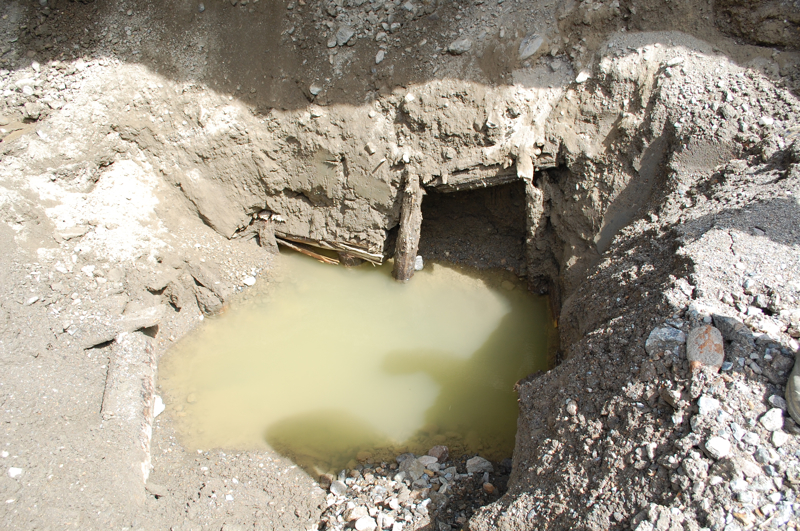 Photo: A. Topham
Here one sees the remains of the old drifts that were dug into the east bank perpendicular to the creek bed.
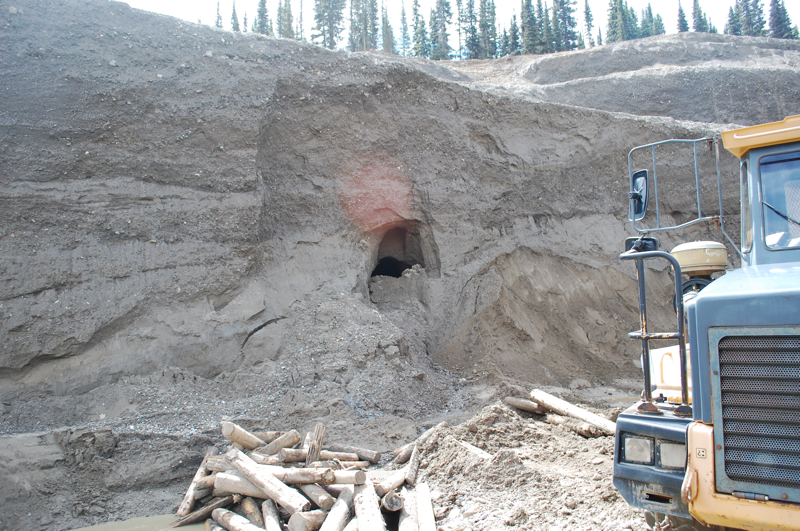 Photo: A. Topham
Exposed drifts dot the high bank of overburden. Below are strewn the round timbers that once held the drifts in place. These timbers are as solid today as they were when first installed a century and half ago.
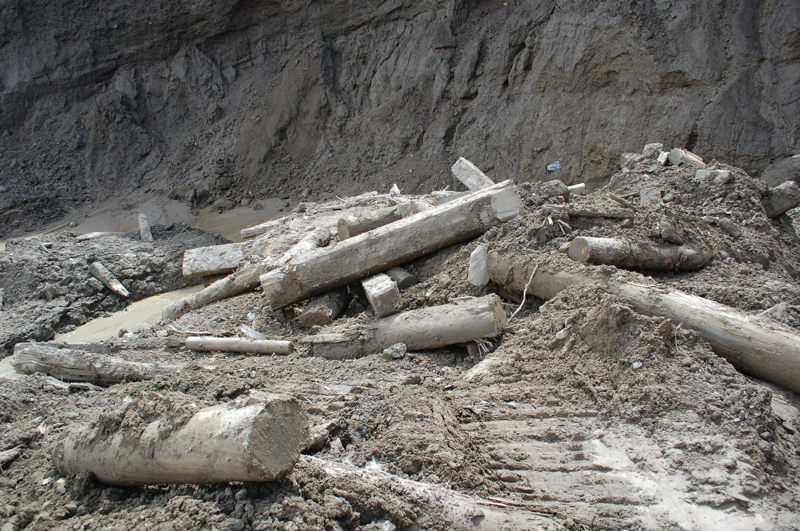 Photo: A. Topham
A close up of the old drift timbers. In the 1960s when a portion of the drifts were refurbished all the timbers used then were squared indicating that they weren’t part of the original workings from the earlier period.
 Photo: A. Topham
Again we see the old drift at the furthest point of excavation to date. Water and slum material continually leak forth from the old tunnels.
 Photo: A. Topham
Chris Winther, President of the Cariboo Mining Association in discussions with Rick Mason. Behind is the backdrop of sheer clay and rock overburden that at one time in the past presented an insurmountable obstacle to the placer miners of old. Today, thanks to modern machinery, these challenges can be met.
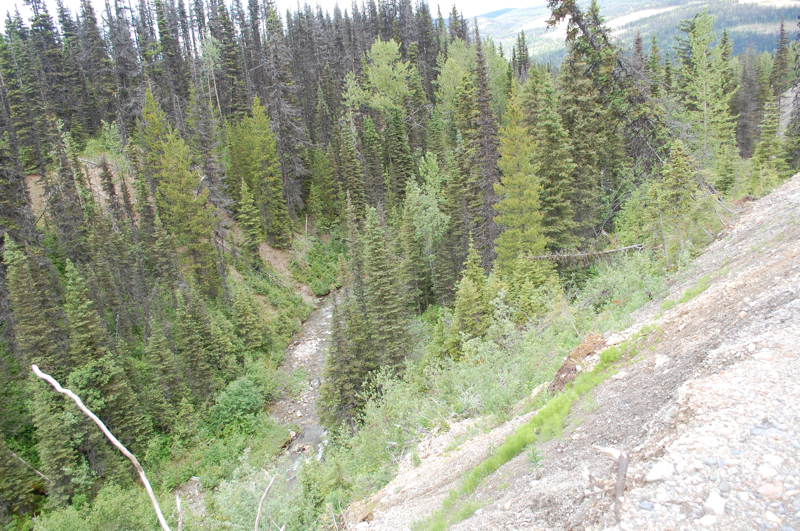 Photo: A. Topham
The steepness of the banks running down to the present day Grouse Creek are visible in this photo.
 Photo: A. Topham
Once again we see the high banks of overburden behind Chris and Rick who are near the upper reaches of the workings on Grouse Creek.
 Photo: A. Topham
The view here is looking up Grouse Creek toward the famed Heron Channel. Presently Hard Up Mining Ltd has about another 600 feet distance to go before reaching their destined goal.
 Photo: A. Topham
Remains of the old track running into one of the many drifts along Grouse Creek. This bit of history is now held in place by the riparian zone that skirts Grouse Creek on either side for a distance of 10 meters.
 Photo: A. Topham
Looking downstream to the wash plant and camp headquarters and beyond toward the Bowron Lake Park the magnitude of the project becomes only that much more prominent and apparent.
 Photo: A. Topham
The iron (equipment) required to process the volume of pay dirt is costly and expensive to operate but without it the chances of ever recovering the remaining sections of the Heron Channel would be impossible to fulfill.
In their business prospectus for Grouse Creek one can read about the early history of Grouse Creek and how due to the “Grouse Creek War” the ground in and around the famed Heron Channel eventually was turned into a Crown Grant. These Crown Grants issued by Queen Victoria virtually guarantee the property owner, “absolute estate in fee simple, the most powerful real estate clause in existence. Today, Crown Grant 13f is one of only a half dozen remaining Crown Grants issued by the Queen in the 1800’s, and a powerful development tool for mining investment.”
Over the years the properties in the area exchanged hands but the owners were never able to muster the material wealth to tackle the project now underway. In 2009 Devlin’s Bench Mining Ltd purchased the ground and since then, along with Rick Mason and Hard Up Mining Ltd, has been pursuing the lore and the lure of this stunning project. Placer miners everywhere are sure to appreciate the scope of this project and I’m certain that everyone is keeping their fingers crossed that before too long those long arms will eventually uncover yet another dream and turn it into a modern day Cariboo gold fields reality.
———
For more information about Grouse Creek, or Devlins Bench Mining Ltd. contact:
Pete Wright
General Manager
office: 250-994-3338
email: wrightcontractingltd@gmail.com
Business inquiries:
Dave Jorgenson
Site Manager
office: 250-994-3338
fax 250-994-3247
email: dave@williamscreekgoldfields.ca
Minesite:
250-994-3337
Links:
http://williamscreekgoldfields.ca/grouse_prospectus.pdf
CMA Letter to Stephen Harper: Scrap Bill C – 68

 The Right Honourable Stephen Harper
Prime Minister of Canada
House of Commons
Ottawa, ON
K1A 0A6
August 17, 2011
Dear Mr. Harper,
Re: Scrapping Bill C – 68
At the regular monthly members meeting of the Cariboo Mining Association (CMA) on August 9, 2011 a motion was put forth and unanimously agreed upon that the CMA write to you and to our MP, the Honourable Richard Harris, expressing our strong feeling that Bill C – 68 in all its entirety be scrapped as per your election promise.
As placer and hard rock miners who, of necessity, require the protection of firearms in the course of our exploration and development work and as legal, law-abiding citizens living in a free and democratic country, it is our firm belief that Bill C – 68 not only infringes upon our basic human rights but also criminalizes lawful owners of guns and places our physical safety at risk.
You may not be aware but the mountainous regions of the Cariboo are still mostly vast tracts of wilderness inhabited by black bear, grizzly, cougar and mountain lions and thus pose a serious and imminent threat to the prospector and to miners out working their claims in these remote areas.
We therefore strongly urge you to follow through with your promise to rid Canada of this unnecessary and draconian law.
Yours truly,
Chris Winther
President
Cariboo Mining Association
Cc: MP Richard Harris
NRA: Goals for Immediate Firearms Legislation Reform
 http://www.nfa.ca/goals-immediate-firearms-legislation-reform
Goals for Immediate Firearms Legislation Reform
• Completely repeal the former bills C-17 and C-68, known as the Firearms Act—including scrapping the firearms registry, firearms licenses, and destroying the records.
• Eliminate firearm licences and the requirement to take any sort of course to own one’s own property; ordinary firearms owners are not a threat to public safety, violent criminals are.
• Eliminate the automatic check of legal firearms owners when a person is stopped for a traffic offence and replace it with an instant check of criminal/parole/probation records; hunters and target shooters are not a threat to public safety – violent criminals are.
• Replace the licensing and registration provisions with a point of purchase instant criminal record check for firearms. This system would keep legal access to firearms away from criminal elements by making use of a practical list of people who should not have firearms, rather than by trying to make lists of those who may.
• Renounce the agreement to implement the UN marking regulations (Firearm Markings Regulation SOR 2004-275) that was passed in 2004.
• Cancel the introduction of the proposed new gun show regulations.
• Curtail the RCMP’s attempts to unilaterally reclassify firearms.
• End prohibitions on magazine capacity.
• Restore handgun hunting as a legitimate use of a handgun.
• Eliminate punitive safe storage and transport requirements that have caused much grief to firearm owners in the absence of any wrongdoing.
• Remove the category of prohibited from firearms ownership so as to allow free exchange of property. The arbitrary nature of the prohibited class is a great affront to ordinary citizens who happen to own these firearms. It is also a means of stealing their property from them as many prohibited category firearms may not be passed on to heirs, or readily sold at their fair market value. If there is to be a “restricted category”, then it must have broader reasons for use, which should allow combined reasons for ownership and use, and it must include at least hunting and self-defence along with the other categories.
• Encourage support for recreational and competitive shooting sports so as to eliminate the negative stigma created by this regressive legislation.
—————–

 The Cariboo Mining Association